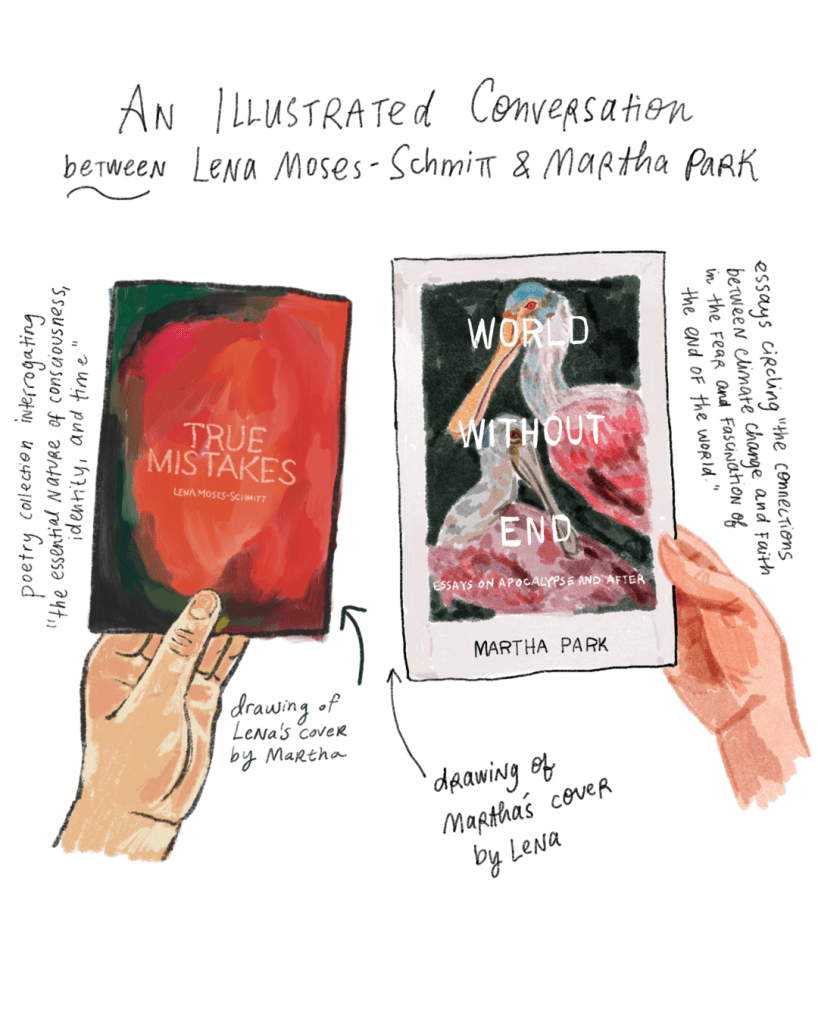
Art and Craft: An Illustrated Conversation Between Lena Moses-Schmitt and Martha Park
Literary Hub
An illustrated conversation with Lena Moses-Schmitt, whose debut poetry collection, True Mistakes, was recently published by the University of Arkansas Press.
What We Pass On: A Conversation with Martha Park and Molly McCully Brown
Image Journal
“Maybe this is all a way of saying that a faith community can be a kind of literary community. I’m obviously really into that.”

Episode 622: The Great American Pyramid
99% Invisible Podcast
I guess, when I think about the Pyramid, what I think it means is that any attempt you have at creating a space to project a single story is ultimately going to fail and that what might work better is letting the world come in instead and letting you know what that space could mean and to be open to a space telling a different story of itself than the one you expected.

Faith Without Certainty
A conversation with Meera Subramanian about spirituality, intergenerational storytelling, and community in times of crisis
Orion Magazine
There’s nothing interesting to me about a story that can’t live and change along with us. What makes scripture sacred to me is the way that these stories continue to grow in meaning over time. What makes them sacred, to me, is not inerrancy but their mutability.

Nonfiction Against the End of the World: An Apocalypse Reading List
Literary Hub
The essays in World Without End explore a range of apocalypses: from the evangelical Christian vision of apocalypse as a God-sent end of the world, to the secular apocalypses unfolding all around us—whether through the climate crisis and mass extinction events, or the degradations of capitalism and extractive industry, or the growing influence of Christian fundamentalism on American civic life—to quiet, private apocalypses, like the bewilderment that accompanies a personal loss of faith.
I have always been drawn to books that grapple with—and seek to undermine, complicate, and create new meanings from—visions of apocalypse. Here are some to consider.

The Good Southern Women Interview
Interview for the Porch / Susannah Felts's F I E L D T R I P Substack
I like the feeling of having a deep connection to a specific place, simply by virtue of time and affection. No place is anonymous: driving by a hospital or grocery store or a cemetery is an opportunity to be reminded of an old wound, or some small miracle, or the way generations of people have lived and died here and rooted me to this place. It all gives me a sense of coherence.

Martha Park’s World by David Waters
Memphis Magazine
Her book is more than a collection of essays and illustrations by a preacher’s kid. It’s the journal of an open-hearted, curious soul during a time of political turmoil and climate change in what Flannery O’Connor called “the Christ-haunted South.” In her book, the would-be memoirist becomes a journalist. She interviews ministers and scientists, landowners and farmers, conservationists and creationists, and other mothers and daughters as she travels from one sacred Southern space to another.

“…this world is the only one we’ve got…”
a conversation with Boyce Upholt on the apocalypses we imagine in the South
southlands
I’m trying to understand the God-sent, world-ending apocalypse that my husband grew up with in the evangelical church, which stems from a particular reading of the Book of Revelation. And I’m trying to understand my own tradition’s understanding of that book as a description of the end, not of the whole world, but of a specific, oppressive empire. I’m also trying to understand the way climate change, biodiversity loss, and mass extinctions can be understood apocalyptically. And I’m wondering what apocalyptic imagination means in an era when white conservative Christianity has made an alliance with oppressive, authoritarian politics.

Memphis Memories:
A Conversation in Letters with Martha Park and Rachel Edelman
Orion Magazine
I think Memphis is the only place I can be religious, to whatever extent I ever will be. I’ve loved living in other places more, but in Memphis I am legible to myself in a different way. In your book, you write, ‘there’s comfort/in a constant ache.’ I think that’s similar to the way I feel, living here again. There is something about faith that will always be unresolved. It’s pleasurable, in its own way, to be proximate to that wound.

A Conversation with Martha Park (’15)
Hollins University's Jackson Center for Creative Writing
Something I’ve written a lot about in the book is how religious language shows up in environmental conversations. When we talk about resurrecting a lost species, or a lost ecosystem, what do we mean by resurrection? Do we all mean the same thing by that? How do different interpretations shape the way we live in the world and with each other?
 martha park