Natural Ends
Orion Magazine
Religious language has a way of creeping into conversations about climate change and environmentalism. There are discussions of “belief” and “doubt;” environmental advocates agonize over how to “convert” people who are skeptical of climate change—especially white evangelical Christians—to ‘believers’ who will put their faith and collective influence into action to curb the worst effects of a warming climate. As I left Ramsey Creek and drove an hour east to Grace Church’s new cemetery, I wondered if burial—a rite of passage in which the material, physical world and any spiritual sense of a life beyond it are always inherently entwined—could offer an entry point for conservative Christians who might otherwise feel uneasy with climate change activism or environmentalism.
The Life Everlasting
Sojourners
This is the logic of resurrection that I can’t quite shake, the internal, embodied rhythms of the earth’s predictable cycles lulling me into believing there will always be more: That what we lose will come back to us, in whatever new forms.

For the Living of These Days
The Bitter Southerner
By being linked so irrevocably to the creation story found in Genesis, evolution now seems imbued with its own “scriptural underpinnings” and theological implications. As a new story — even as an alternate origin story — evolution suggests to me that people are not a finished product. Instead, we are the promise of ongoing change that will extend far beyond any of our individual lives. We have been otherwise before, and if we continue on this earth long enough, we will be otherwise again. Thanks be to God.

‘With This Inheritance, I Was Getting Too Much’
Sojourners
The promised land story reminds us that “land promise and land violence,” as Brueggemann wrote, are “twin claims that … cannot be separated out.” Is there anything in the story of the promised land that can be redeemed? Is there anything in this inheritance that can be made, somehow, instructive? In his writing reexamining the promised land, Brueggemann used a phrase — “epistemological repentance” — that I wrote repeatedly in my notebook, as a kind of incantation.
World Without End
Guernica
It seemed there was no real end of the world to be found here—only massive and continual change, not so unlike the world we live in now. I wonder if change might be harder to imagine—maybe even harder to bear—than a definitive end.

This is Paradise
In the long list of plants and animals facing similar challenges and dwindling numbers, it might seem hard to justify the amount of attention and resources that the Florida torreyas command. Focusing on one ailing species often feels like a choice to ignore another. Compared with the Florida yew, with its cancer-fighting potential, or the gopher tortoise, whose deep, winding tunnels protect other species fleeing fires, it’s hard to know what the Florida torreya offers — what it means — other than its role in a story projected onto it.

The Charged World
Image Journal
My father didn’t baptize me. Two of his old seminary buddies did it. But when I was a child he washed my hair every night. Kneeling on the cold tile, he would pour water over my head with a plastic lemonade pitcher. He would wring my hair dry, wrap me in warm towels, and put me to bed. Now, I think of that ritual as our own nightly baptism.

The Ark at the End of the World
In the faith tradition I grew up in, science and religion were compatible — not competing — sources of truth. This made any tensions I felt between the world and the church negotiable, a question of my ability to hold multiple perspectives in tension, rather than choosing one over the other. But the certainty, the demands, of a more conservative theology might be a more effective tool for retention rates. The religion I was raised in never demanded that I choose it and forsake all else, so I never did.

Writing that Hurts
These objects taught Doty how to love the world, and his descriptions demonstrate his argument: that the language of ideas is “a phantom language, lacking in the substance of worldly things, those containers of feeling and experience, memory and time”; that memory does what art does, “which is to take the world within us and somehow make it ours”; that description, borne of outward attention to the world, ultimately gives us back ourselves.

Crying in Church
Image Journal
It should not surprise me, now, that my father seems so inseparable from the ritual of worship itself. But in the last year I’ve spent going to church, I’ve felt the rhythm of ritual becoming more persistent, insistent somehow, in my body, in my own burgeoning understanding of what faith might look like without my dad standing at the threshold and welcoming me inside.
The Last Time
Terrain.org
Each week, my father wrote his sermons at the dining room table with a worn Bible spread open before him, filling hundreds of notebooks with his tight, tiny script. Whenever I caught a glimpse of him hunched over his notebook, his work seemed as rare as dowsing, as specialized as horology, utterly mysterious to me.
articles
When a Green Book Site Goes Up For Sale
The Atlantic's CityLab
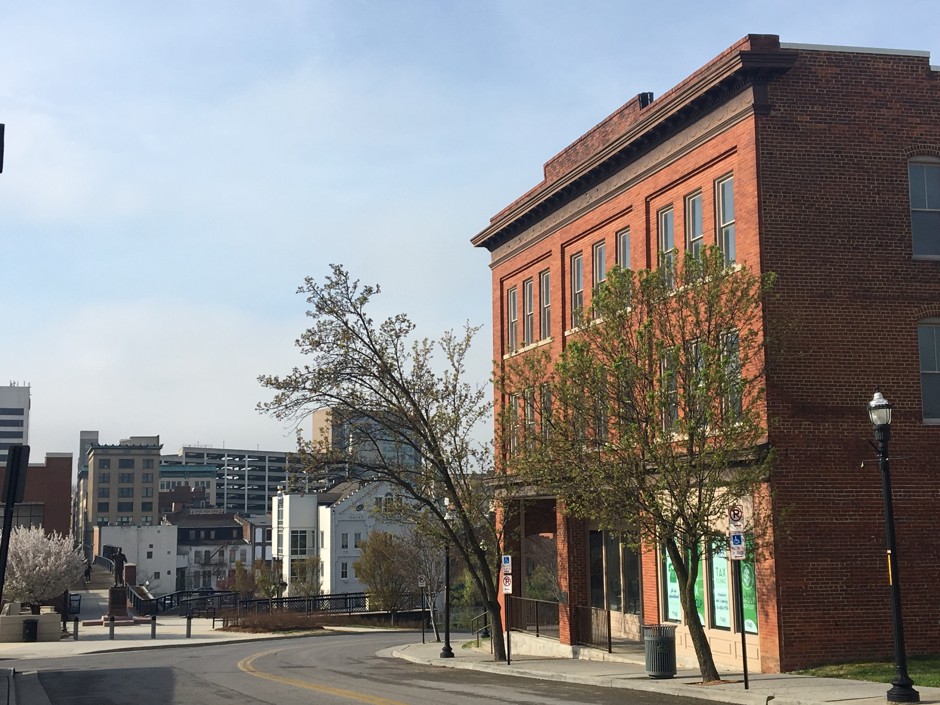
Despite new landscaping and sidewalks, Henry Street appears bombed out—deliberately attacked. Some Gainsboro residents think that is, in fact, the case—that the urban renewal projects which decimated the neighborhood were targeting Henry Street and the revenue of its black businesses. “This was war,” a community leader recently told me, “plain and simple.”

Memphis Burning
Memphis Flyer
The lynching of Ell Persons is a story no one told me about my home. I never heard Persons’ name in a history class or read about the lynching in a textbook. I first encountered Persons’ story in my own reading, years after I finished high school in Memphis and moved away for college. When I went looking for the site where Persons was lynched, there was nothing to suggest whether I was in the right place.

When Memphis Fell for a Pyramid Scheme
The Atlantic's CityLab
Articles spanning the last 50 years of Pinch history often described it as on the cusp of something: The neighborhood was “making a modest comeback,” “slowly coming back to life,” “poised for a Renaissance,” “nearly dormant,” “once-thriving,” “coming back,” and “not dead yet.” But wherever the Pinch was headed, it never seemed to arrive.
interviews & conversations

Episode 622: The Great American Pyramid
99% Invisible Podcast
I guess, when I think about the Pyramid, what I think it means is that any attempt you have at creating a space to project a single story is ultimately going to fail and that what might work better is letting the world come in instead and letting you know what that space could mean and to be open to a space telling a different story of itself than the one you expected.

Faith Without Certainty
A conversation with Meera Subramanian about spirituality, intergenerational storytelling, and community in times of crisis
Orion Magazine
There’s nothing interesting to me about a story that can’t live and change along with us. What makes scripture sacred to me is the way that these stories continue to grow in meaning over time. What makes them sacred, to me, is not inerrancy but their mutability.

The Good Southern Women Interview
Interview for the Porch / Susannah Felts's F I E L D T R I P Substack
I like the feeling of having a deep connection to a specific place, simply by virtue of time and affection. No place is anonymous: driving by a hospital or grocery store or a cemetery is an opportunity to be reminded of an old wound, or some small miracle, or the way generations of people have lived and died here and rooted me to this place. It all gives me a sense of coherence.

Martha Park’s World by David Waters
Memphis Magazine
Her book is more than a collection of essays and illustrations by a preacher’s kid. It’s the journal of an open-hearted, curious soul during a time of political turmoil and climate change in what Flannery O’Connor called “the Christ-haunted South.” In her book, the would-be memoirist becomes a journalist. She interviews ministers and scientists, landowners and farmers, conservationists and creationists, and other mothers and daughters as she travels from one sacred Southern space to another.

“…this world is the only one we’ve got…”
a conversation with Boyce Upholt on the apocalypses we imagine in the South
southlands
I’m trying to understand the God-sent, world-ending apocalypse that my husband grew up with in the evangelical church, which stems from a particular reading of the Book of Revelation. And I’m trying to understand my own tradition’s understanding of that book as a description of the end, not of the whole world, but of a specific, oppressive empire. I’m also trying to understand the way climate change, biodiversity loss, and mass extinctions can be understood apocalyptically. And I’m wondering what apocalyptic imagination means in an era when white conservative Christianity has made an alliance with oppressive, authoritarian politics.

Memphis Memories:
A Conversation in Letters with Martha Park and Rachel Edelman
Orion Magazine
I think Memphis is the only place I can be religious, to whatever extent I ever will be. I’ve loved living in other places more, but in Memphis I am legible to myself in a different way. In your book, you write, ‘there’s comfort/in a constant ache.’ I think that’s similar to the way I feel, living here again. There is something about faith that will always be unresolved. It’s pleasurable, in its own way, to be proximate to that wound.

A Conversation with Martha Park (’15)
Hollins University's Jackson Center for Creative Writing
Something I’ve written a lot about in the book is how religious language shows up in environmental conversations. When we talk about resurrecting a lost species, or a lost ecosystem, what do we mean by resurrection? Do we all mean the same thing by that? How do different interpretations shape the way we live in the world and with each other?
 martha park
Leave a comment